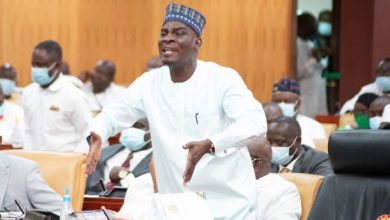
The Chief Executive Officer of the Ghana Gold Board (GoldBod), Sammy Gyamfi, has explained the institution’s financing model, saying it is designed to support gold purchases while gradually reducing its reliance on the Bank of Ghana (BoG) as an intermediary.
Speaking during a Space conversation on X on Sunday, August 9, 2026, Mr Gyamfi said GoldBod’s financing structure had evolved following the end of the Bank of Ghana’s Domestic Gold Purchase Programme, under which its predecessor, the Precious Minerals Marketing Company (PMMC), acted as a buying agent for the central bank.
He said it was important to distinguish between funds used to purchase gold and resources required to meet GoldBod’s operational costs.
“When we talk about financing or funding for Gold Board, you’re talking about number one, the revolving funds that the Gold Board deploys for gold purchases,” he said.
Mr Gyamfi explained that during the previous Domestic Gold Purchase Programme, the Bank of Ghana provided funds because it was the owner of the programme and ultimately received the gold purchased through PMMC.
“So, if I’m your agent and you’re the principal, you give me money to buy gold for you. That is not pre-financing of Gold Board. That is Bank of Ghana giving money to an agent to buy gold,” he said.
He said the arrangement continued until February 2026, when GoldBod assumed responsibility for the gold trade under the new regime.
Under the new model, Mr Gyamfi said GoldBod’s gold purchases are financed through commercial banks and businesses that require foreign exchange for their transactions. He said the Bank of Ghana initially acted as an intermediary by converting cedi funds from commercial banks into dollars for GoldBod’s purchases.
He stressed that this should not be confused with the central bank using its reserves to finance GoldBod.
“You must understand the difference between intervention and intermediation. The two words are not the same,” he said.
“Intervention is where the central bank forces its reserves to give effect to the market. Intermediation is where the central bank goes as an intermediary. Simply put, a middleman.”
Mr Gyamfi said GoldBod ended the Bank of Ghana’s intermediary role in July because the central bank’s Domestic Gold Purchase Programme had ended and GoldBod was no longer acting as its agent.
“We don’t want to have any issues with the IMF,” he said.
GoldBod is now pursuing alternative financing mechanisms, including advance dollar payments from international gold off-takers and funded forward foreign exchange transactions with commercial banks.
Under the forward foreign exchange arrangement, Mr Gyamfi said GoldBod would sell expected future dollar inflows from gold exports to commercial banks in advance to raise funds for gold purchases without involving the Bank of Ghana as an intermediary.
He disclosed that GoldBod had tested the model on August 3, raising US$75 million and converting the cedi equivalent into dollars within 48 hours without using the Bank of Ghana.
He said GoldBod was working with the Bank of Ghana and the Ministry of Finance to refine the framework, with further adjustments expected by August 19.
“It is our expectation that once we are done, the Gold Board will stand on its own because that is what we want. We don’t want to depend on the Bank of Ghana again as an intermediary raising money for us,” Mr Gyamfi said.
On operational costs, Mr Gyamfi said GoldBod was expected to finance its activities through its trading operations, either by incorporating costs into its pricing or using trading gains.
He said the government had also decided to provide funding equivalent to five per cent of the value of gold purchased under a three-year reserve accumulation programme aimed at building Ghana’s foreign exchange reserves to cover 15 months of imports.
Mr Gyamfi described the allocation as a “baseline programme implementation cost” rather than a reduction in GoldBod’s losses.
He said the financing model was ultimately intended to enable GoldBod to operate independently while supporting Ghana’s broader objective of increasing foreign exchange earnings and strengthening international reserves.
Source:Fiilafmonline/CitiNews