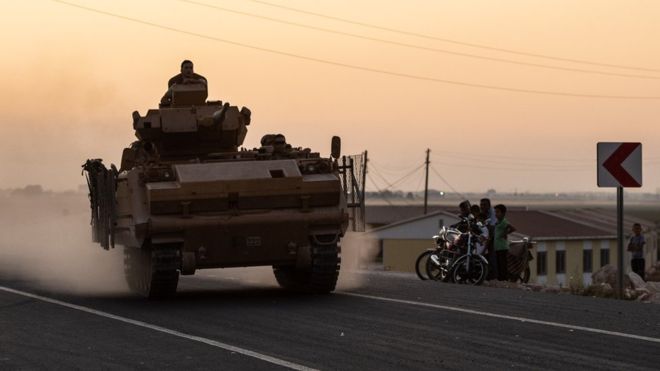
The UAE accused Iran of a “brazen” attack on two tankers in the Strait of Hormuz on Monday, killing one and wounding eight, as Donald Trump said the US would impose a 20% charge as part of a new blockade on the waterway.
The US president said they were hitting Iran “very hard” as strikes were launched for the third consecutive night amid escalating attacks between the two countries.
Iran’s foreign minister responded to the announcement of a blockade by saying that Tehran would remain the Strait’s “GUARDIAN” – using Trump’s word.
The dispute over control of the Strait of Hormuz threatens to derail efforts to end their war, but Trump insisted a deal was still possible.
As tensions over the international waterway ramped up, the United Arab Emirates said on Monday night that Iranian cruise missiles targeted two national tankers, killing an Indian crew member and wounding eight others, four of which were serious.
Six of those injured were Indian, while two were Ukrainian, the UAE Ministry of Defence said in a statement on X.
“The Ministry of Defense condemns this brazen attack, which constitutes a serious violation and a clear breach of international law, threatening the security and stability of the region,” it said.
Iran’s Islamic Revolutionary Guard Corps (IRGC) later confirmed the strikes via a statement to Telegram, where it said two tankers had ignored warnings, turned off navigation systems and attempted to pass through a mined route.
In response, the IRGC said it had hit the tankers and disabled them.
It added that “co-operation with the aggressor enemy” would only lead to regret, damage and delays in opening the Strait – as well as the “creation of an energy crisis in the world”.
Oil prices edged higher in Asian trade on Tuesday. Brent crude was up by 0.7% at $83.87 (£62.79) a barrel, while US-traded oil was 0.9% higher at $79.04.
That followed a more than 9% jump in the price of Brent on Monday as the conflict escalated.
The strait remains a key flashpoint between the US and Iran, with both sides clashing over the waterway’s control on Monday after exchanging strikes in the region over Sunday night.
In a Truth Social post earlier in the day, Trump said the US was reinstating a naval blockade of Iranian ports and would impose a 20% charge on all cargo shipped through the Strait of Hormuz.
He said this would stop “Iran’s ships or customers” from entering or leaving the key oil shipping route, but “all other countries will have fair and open use of the Strait”. The blockade will be in effect from 16:00 Eastern Time (20:00 GMT) on Tuesday.
“The U.S.A. will be, from this point forward, known as “THE GUARDIAN OF THE HORMUZ STRAIT,” but as such, and as a matter of FAIRNESS, will be reimbursed, at the rate of 20% on all cargo shipped, for any and all costs necessary to do the job of providing safety and security to this very volatile section of the World,” he wrote.
Speaking to reporters at the White House, Trump said the US was “hitting them very hard”.
“We’re knocking out all of their offensive capability. And we’re controlling the Strait,” he added.
Asked about peace talks between the two countries, he said: “Yeah, I think a deal is possible, sure, I do.”
US Central Command (Centcom) said the strikes were launched at 16:45 Eastern Time (20:45 GMT) on Monday at “the Commander in Chief’s direction”.
Several hours later, it confirmed it had struck military targets across Iran, including Bushehr, Chah Bahar, Jask, Konarak, Abu Musa, and Bandar Abbas, which it says was to “further degrade Iran’s ability to attack commercial shipping”.
Iran’s army said it had targeted US military assets in Kuwait in response, Iranian state media reported.
Attacks were also launched on Bahrain, where the IRGC said it destroyed several weapons depots, a satellite communications centre and a building housing US forces.
Early on Tuesday morning, the IRGC also confirmed they had targeted an air base in Jordan with ballistic missiles.
Source:Fiilafmonline/BBC