Polls have opened in Ethiopia’s general election as conflict rages in parts of the country, meaning many people will not be able to vote.
In fact, the whole northern region of Tigray, which has been trying to recover from a brutal civil war that ended in 2022, has been totally excluded from the poll.
It is the seventh election since the downfall of the military regime in 1991 – an upheaval that led to Eritrea’s secession two years later – and it takes place as Ethiopia’s relations with its northern neighbour are once again dangerously fraught.
The media is tightly regulated and many organisations, including the BBC, have not been given press accreditation.
Who is likely to win?
Prime Minister Abiy Ahmed – although he is not directly elected. Voters elect representatives to the 547-member parliament and the party that secures at least 274 seats earns the right to form the next government to lead the country for the next five years.
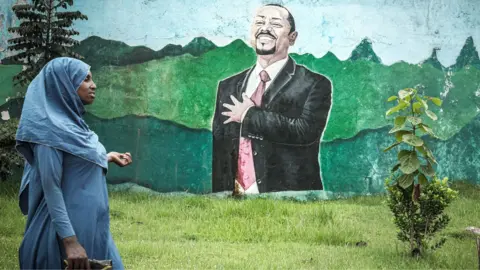
Abiy, 49, came to power in 2018 following widespread anti-government protests against the Ethiopian People’s Revolutionary Democratic Front (EPRDF), a coalition – dominated by politicians from Tigray – that had ruled since 1991.
He went on to dissolve the EPRDF, of which he was a part, and replace it with his Prosperity Party, a more centralised and less federal form of governing.
 AFP via Getty Images
Prof Merera Gurdina, a veteran opposition politician and member of the Oromo Federalist Congress, alleges the upcoming election is the least competitive in Ethiopia’s recent history.
“We are participating symbolically because the law says you cannot boycott elections consecutively. We are participating, mainly to avoid deregistration,” he told the BBC.
When Abiy first assumed office, he was hailed as a champion of democracy and press freedom after releasing hundreds of politicians and journalists from prison.
He was awarded the 2019 Nobel Peace Prize mainly for bringing an end to the 20-year military stalemate with neighbouring Eritrea.
Seven years later things could not be more different.
How did Abiy blot his copybook?
Critics accuse his government of suppressing dissent, forcing opponents into exile and arresting political rivals.
Under Abiy’s watch the government went to war in 2020 with Tigray’s leaders in a two-year conflict estimated by the African Union’s mediator to have killed some 600,000 people and which drove the region to the precipice of famine.
According to Reporters Without Borders’ 2025 press freedom index, Ethiopia came 148 out of 180 countries.
In its September 2025 publication, Human Rights Watch condemned Ethiopia’s government for arbitrarily arresting journalists and media professionals and called for an end to the harassment of independent journalists.
After the credentials for three reporters working for the Reuters news agency were revoked in February, the Committee to Protect Journalists said there was “a troubling pattern of repressive regulatory action against international and independent press in Ethiopia”.
What do the prime minister’s supporters say?
They argue that Abiy has transformed the country for the better.
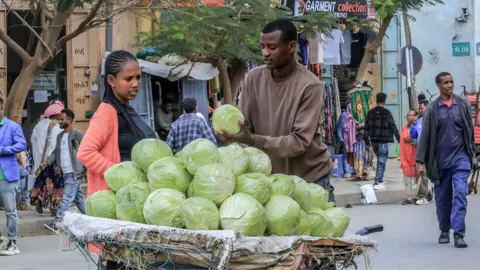
The capital, Addis Ababa, symbolises these reforms as it is undergoing a rapid urban transformation, in what is known as the prime minister’s “Corridor Development” and “Riverside” projects.
Though these initiatives to improve transport and public spaces have too faced criticism for mass demolitions that have displaced tens of thousands of residents.
 AFP via Getty Images
Abiy’s economic reforms have received support from the International Monetary Fund and the World Bank, under the proviso the country liberalises its foreign currency exchange market and gets a handle on its debt. This stood at $36.5bn (£27.1bn) in 2024, according to the World Bank.
With a population of 135.9 million, Ethiopia is Africa’s second most-populous nation – after Nigeria – and one of the continent’s fast-growing economies, according to World Bank estimates.
This is despite the ongoing insecurity in regions such as Amhara and Oromia, the hangover from the Tigray war and the rising costs of goods and services.
The country’s GDP per capita – which is a measure of a person’s average income – is projected to reach $1,133 in 2026, compared to $641 in 2016.
Source:Fiilafmonline/BBC