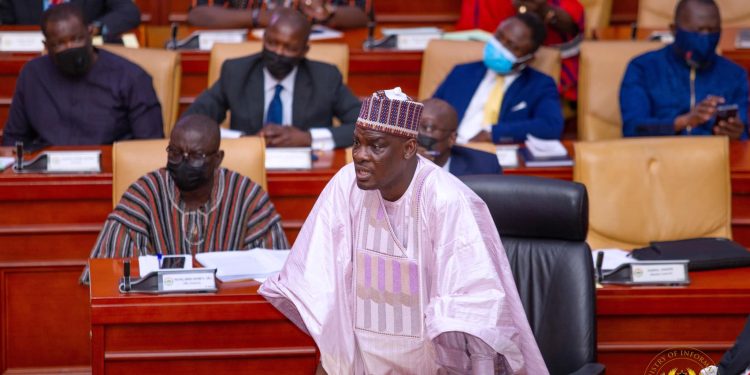
The Education Minister and Member of Parliament for Tamale South, Haruna Iddrisu, has urged the government to begin fulfilling its manifesto promise to increase the District Assemblies Common Fund (DACF) allocation from 5% to 7.5% of the country’s total projected revenues.
He proposed a phased increase beginning in 2027, arguing that the move would strengthen decentralisation and give Metropolitan, Municipal and District Assemblies (MMDAs) greater financial independence to deliver essential services.
Speaking at the second National Dialogue on Decentralisation and Responsive Governance on Monday, August 10, Mr Iddrisu said the government could increase the DACF allocation by one percentage point in 2027 and another one percentage point in 2028 as part of efforts to fulfil the NDC manifesto promise.
“Now, the elephant in the room is the District Assemblies Common Fund. We said in the NDC manifesto that we would adjust the DACF from 5% to 7.5%. So, as a government, we have said that we will increase the DACF.
“The DACF under the Atta Mills government was 7.5%, so we want to walk gingerly and gradually towards the same. In 2027, you can give one per cent, and in 2028 add another one per cent, and we would have honoured the manifesto pledge of adjusting the DACF to 7.5%,” he said.
Mr Iddrisu said the proposed increase would support the government’s decentralisation agenda, including plans to deepen the role of MMDCEs and give local authorities greater responsibility for the delivery of health and education services.
He explained that one percentage point of the additional allocation could be dedicated to health, allowing metropolitan assemblies, for instance, to recruit health professionals directly.
He said another percentage point could be allocated to education as part of efforts to strengthen local governance and improve accountability.
“President Mahama’s thinking and vision on deepening democratic decentralisation, including the election of MMDCEs, is to dedicate that one per cent increase to health, decentralisation and devolution.
“So that a metropolitan assembly can now recruit doctors and nurses on its own, making use of that one per cent allocation for health.
“Then the other one per cent will go to education, devolution and the democratisation of education. This is the thinking of the President. These were the principles we agreed to.
“So we cannot be walking back on policy principles that we all agreed to that deepen democratic decentralisation, make it competitive and elective, open it up, and deepen citizens’ accountability,” he said.
The Education Minister further stressed that the financial independence of MMDAs was critical to effective decentralisation, arguing that assemblies should not have to rely heavily on releases from the central government to perform their functions.
He said excessive dependence on central government releases could undermine the ability of local authorities to function effectively.
“But we can’t do it if the DACF is not available. Maybe the Local Government Minister can’t say it, but I’ll say it for him: if he is going to rely on releases from the Finance Ministry, the ministry won’t function effectively.
“Just like me, the Education Minister, I won’t function well without GETFund,” he said.
Source:Fiilafmonline/CitiNews