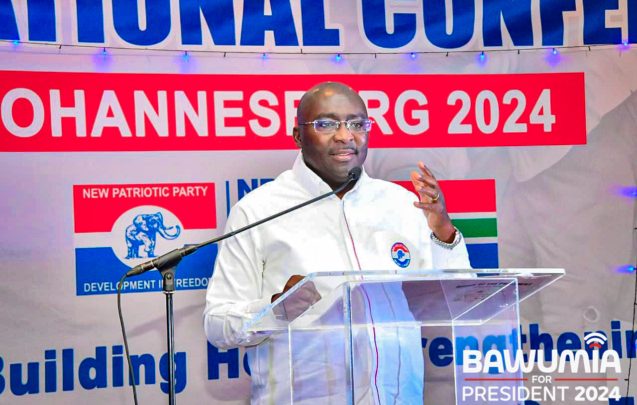
Governance, Religion and Policy Think Tank, IGER Africa, has projected a victory for former Vice President Dr Mahamudu Bawumia in the flagbearer elections of the New Patriotic Party (NPP).
Founder & President of IGER Africa, Paul Abrokwa, described Dr Bawumia as an experienced politician and an economist.
However, he noted the religious factor is likely to work against Dr Bawumia in the 2028 general elections.
The NPP will be going to the polls on Saturday, January 31, to elect its flagbearer. Dr Bawumia, Kennedy Agyapong, Kwabena Agyei Agyepong, Dr Bryan Acheampong and Dr Yaw Osei Adutwum are all contesting to be elected.
In a statement, Paul Abrokwa,” Dr. Mahamudu Bawumia’s prospects of winning the NPP presidential primary are strong due to his political experience, economic credentials, and party support. However, the religious dynamics of Ghana’s electorate present a significant hurdle for his success in the 2028 general election.
“The predominance of Christianity among voters, coupled with potential religious polarisation and strategic mobilisation by opponents, may limit his ability to secure a broad national mandate. IGER-AFRICA’s research underscores the critical need for candidates to navigate religious sensitivities carefully and promote inclusive narratives to succeed in Ghana’s pluralistic political landscape.”
Dr. Mahamudu Bawumia, the current Vice President of Ghana and a leading figure in the New Patriotic Party (NPP), is widely seen as a strong contender to win the party’s presidential primary ahead of the 2028 elections. However, despite his political experience, economic expertise, and popularity within the NPP, there are significant religious dynamics in Ghana that could complicate his chances of winning the general election. Analyzing this scenario through the lens of IGER-AFRICA’s core mandate and research on political behavior and religion in Ghana provides a nuanced understanding of the challenges Bawumia may face.
Why Dr. Bawumia May Win the NPP Presidential Primary
– Strong Party Loyalty and Track Record: As Vice President since 2017, Bawumia has been a key figure in the NPP’s governance, particularly noted for his role in economic policy and digital innovation. His technocratic image and association with the party’s successes strengthen his appeal among party delegates and grassroots members.
– Economic Expertise: Bawumia’s background as an economist and his role in implementing fiscal and monetary policies have earned him respect within the party and among voters who prioritize economic growth and stability. This expertise is a significant asset in intra-party contests where competence is highly valued.
– Party Structure and Support: The NPP’s internal dynamics and delegate system often favor candidates with strong networks within the party machinery. Bawumia’s long-standing involvement and influence in the party’s organizational structures position him well to secure the nomination.
– Ethnic and Regional Support: Bawumia enjoys substantial support in the Northern regions of Ghana, where his ethnic background resonates strongly. This regional base is crucial in the delegate-driven primary process.
Religious Factors Influencing the General Election Outcome
Ghana is a religiously diverse country, with Christianity and Islam being the two dominant faiths. Religion plays a significant role in shaping voter preferences and political alignments. IGER-AFRICA’s research highlights how religious identity can influence electoral outcomes, particularly in a multi-religious society like Ghana.
– Religious Demographics and Voting Patterns: Christianity constitutes about 71% of Ghana’s population, while Muslims make up approximately 18%. The remaining population adheres to traditional African religions or other faiths. Historically, religious affiliation has influenced party loyalty and voting behavior, with some Christian-majority areas leaning towards the opposition National Democratic Congress (NDC) and Muslim-majority regions showing varied allegiances.
– Religious Identity and Political Perception: Dr. Bawumia is a Muslim, and while Ghana is known for religious tolerance, there are subtle undercurrents of religious bias that can affect voter behavior in national elections. IGER-AFRICA’s studies indicate that candidates’ religious identities can become focal points in election campaigns, sometimes influencing voters’ perceptions of inclusiveness and representation.
– Christian Majority’s Electoral Influence:Given that Christians form the majority of the electorate, their collective voting behavior can decisively impact the general election outcome. If sections of Christian voters perceive a Muslim candidate as less representative of their values or interests, this could reduce Bawumia’s appeal beyond the NPP base.
– Religious Mobilization by Opponents: Political opponents may exploit religious sentiments to mobilize voters, framing the election as a contest of religious representation. This strategy can polarize the electorate and diminish cross-religious support for a Muslim candidate.
– Interfaith Relations and Campaign Messaging: IGER-AFRICA’s research stresses the importance of inclusive campaign messaging that transcends religious divides. Failure to effectively communicate a unifying vision that appeals to both Christians and Muslims could hinder Bawumia’s ability to build a broad coalition.
Conclusion
Dr. Mahamudu Bawumia’s prospects of winning the NPP presidential primary are strong due to his political experience, economic credentials, and party support. However, the religious dynamics of Ghana’s electorate present a significant hurdle for his success in the 2028 general election. The predominance of Christianity among voters, coupled with potential religious polarization and strategic mobilization by opponents, may limit his ability to secure a broad national mandate. IGER-AFRICA’s research underscores the critical need for candidates to navigate religious sensitivities carefully and promote inclusive narratives to succeed in Ghana’s pluralistic political landscape.
Source:Fiilafmonline/3News